
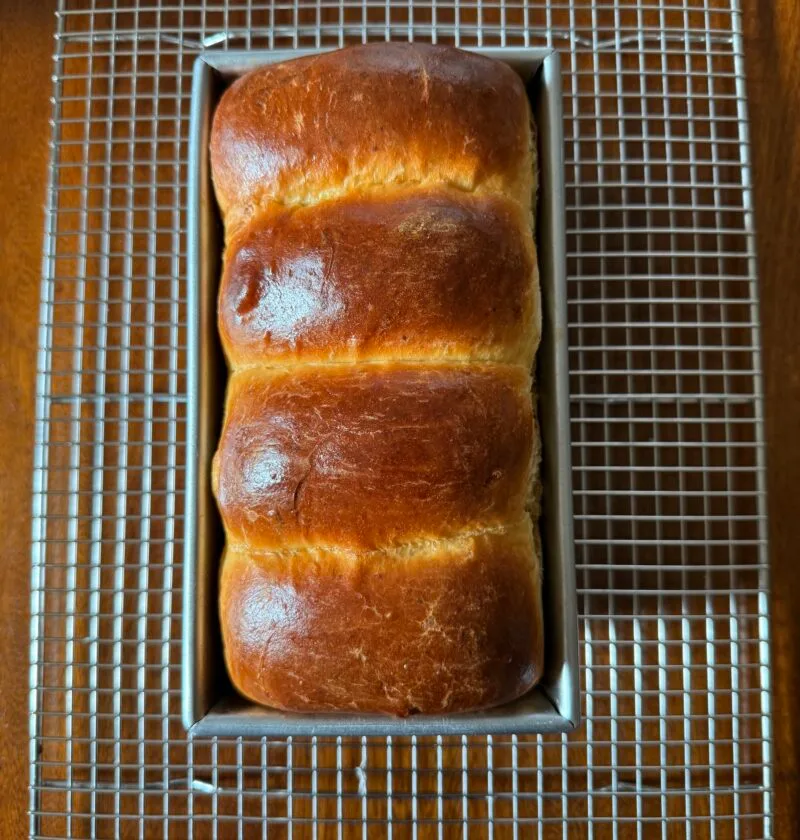
Japanese Milk Bread has officially become my favorite yeast bread!
If you’ve never tried it, you’re in for a treat. It’s incredibly soft, fluffy, and light, with a slightly sweet, milky flavor.
It is delicious all by itself, but it’s also perfect for toast, or simply warm with a little butter. Honestly, it’s hard to resist! 😍
A Yeast Bread That Changed My Mind
I have to admit, though, that I’ve always been a little intimidated by baking with yeast.
As an amateur cook and baker, I used to find all the little details overwhelming—weighing ingredients, knowing when the dough had been kneaded enough, and especially figuring out when the dough had risen sufficiently.
Then I discovered the Big Book of Bread by King Arthur Company, and it completely changed my attitude toward bread baking.
This is honestly one of the simplest and most straightforward bread books I’ve ever used. The instructions are so clear, there’s very little guesswork, and I love that the recipes include measurements in both cups and grams.
And this Japanese milk bread was such a happy discovery!
I’ve already made it several times, and every single time it has turned out beautifully—soft, fluffy, tender, and consistent.
The best part? You don’t need to be an experienced bread baker to make this.
If you’re new to working with yeast, I think this is a wonderful recipe to start with. And if you already bake bread regularly, you’ll probably appreciate how simple and clearly explained everything is.
There’s just one thing to remember: be patient with the rising time! This is the part you really don’t want to rush.
I never thought I’d say this, but I think I’m officially hooked on yeast baking! 😄🍞
Now I just need to decide which bread from the book to try next!
Here is my instructional video:
Japanese Milk Bread
All links in this post are affiliate links. This means I may earn a small commission if you click through and make a purchase, at no additional cost to you.
Ingredients
-
Tangzhong
- Dough
Instructions
-
Make the Tangzhong
- In a small saucepan, whisk together the flour, milk, and water until smooth and lump-free. Bring the mixture to a boil, then reduce the heat to low. Cook, whisking constantly, for 3–5 minutes, until the mixture thickens enough that the whisk leaves a clear trail that does not immediately come back together. Make the dough
- In the bowl of a stand mixer, combine the tangzhong, flour, sugar, milk powder (if using), yeast, salt, milk, beaten egg, and melted butter. Attach the dough hook and mix on medium-low speed until a soft, sticky dough forms, scraping down the sides of the bowl as needed. Increase the speed to medium-high and continue mixing until the dough becomes smooth, elastic, and forms a ball. The dough will remain slightly sticky. Continue mixing until the dough has strengthened enough to pull away from the sides of the bowl, about 15 minutes. Cover the bowl with plastic wrap and let the dough rise at room temperature until puffy and doubled in size, about 1½–2 hours.
- Lightly grease an 8 1/2 x 4 1/2 inch pan with butter or pan spray.
- Lightly flour a work surface, then ease the dough out of the bowl onto the work surface. Gently form the dough into a square and divide it into 4 equal portions (each about 134 grams). Flatten each piece of dough into a 6 × 4-inch rectangle, then fold the short ends toward the center. Flatten the folded pieces into rectangles again (this time about 5 × 3 inches) and, starting with a short side, roll each piece into a log about 3½ inches wide. Place the logs seam side down in the prepared loaf pan, arranging them side by side in a row of four. Cover the pan (with the plastic wrap)and let the dough rise at room temperature until it crowns about ¾ inch over the edge of the pan, about 1½ -2 hours. Toward the end of the rising time, preheat the oven to 350°F.
- Lightly brush the top of the loaf with a thin layer of the beaten egg. Bake until it is glossy and deep golden brown on top and the internal temperature reaches at least 190°F, about 30 minutes. Remove the loaf from the oven and cool it briefly in the pan before turning it out onto a rack to cool completely. Let the loaf cool completely before slicing.
Notes
Benefits of using tangzhong: Unmatched Softness: It creates a pillowy, tender, and bouncy crumb. Longer Shelf Life: The trapped moisture helps prevent the starches from recrystallizing, meaning the bread stays soft and fresh for days without stale hardening. Better Handling: It allows for a higher-hydration dough that remains cohesive and easy to knead rather than overly sticky.